How the clocks drift
Two people can both feel time pass normally and still disagree, afterwards, about how much of it passed. Gravity is what pulls them apart.
1 hour on Miller’s planet 7 years on Earth
Stand on Miller’s planet
Move the slider to choose how long you stay. The clocks in the margins follow it.
Meanwhile on Earth
The slider starts where the film does: about 3 hours 20 minutes, the 23 years Romilly counted.
Why gravity slows a clock
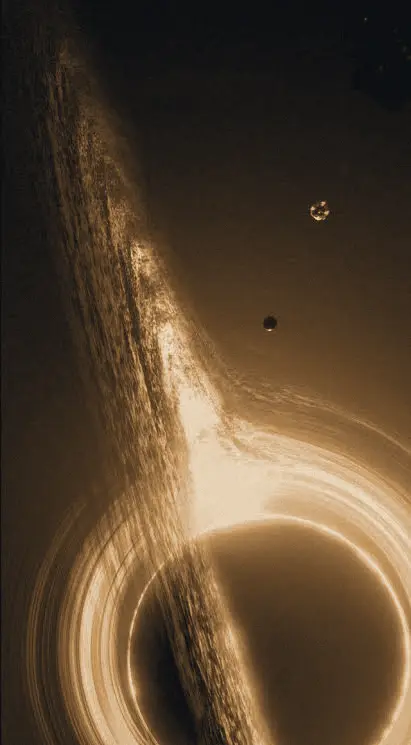
A clock deep in a gravity well ticks slower than a clock far from it. Neither owner notices anything strange. The difference only appears when the two clocks are compared.
Gargantua is huge and spins close to the limit physics allows, which lets a planet orbit very near it without falling in. Miller’s world sits in that orbit, about as deep in the well as anything can stay.
The film puts the exchange rate at one hour for seven years: roughly 61,000 hours outside for every hour on the surface. The Endurance waits much farther out, so Romilly ages almost as fast as Earth does.
The physicist Kip Thorne advised the production. The tesseract is the one place the story goes past known physics, a room where time is laid out like a corridor, and it is why the Earth clock on the timeline runs backwards there.
Every age, side by side
| Moment | Cooper’s clock | Earth clock | Murph’s age | Where the number comes from |
|---|---|---|---|---|
| Cooper leaves | 0 | Year 0 | 10 | Murph’s age widely given as ten |
| Through the wormhole | about 2 years | about 2 years | about 12 | Stated: about two years to Saturn |
| Leaves Miller’s planet | + about 3 h 20 min | + 23 years, 4 months, 8 days | about 35 | Stated: 1 hour = 7 years; Romilly’s count |
| Mann’s planet | + months | + months | about 36 | Estimate |
| Gargantua slingshot | + hours | + 51 years (for Brand) | about 87 at home | Stated: the pass costs 51 years |
| Murph decodes the watch | outside time | about year 27 | about 36 | Estimate |
| Cooper Station | about 2.7 years lived | about 84 years | about 94 | Stated: calendar age 124; rest assumes he left at about 40 |
Stated, or estimated
The film says
- About two years to reach Saturn.
- One hour on Miller’s planet equals seven years on Earth.
- Romilly waited 23 years, 4 months and 8 days.
- The slingshot around Gargantua costs 51 years.
- On Cooper Station, Cooper is 124 years old.
This site assumes
- Murph is ten when her father leaves.
- The leg from Miller’s planet to Mann’s takes months, not years.
- Cooper is about 40 at launch, so 124 means about 84 years have passed on Earth, and Murph is about 94.